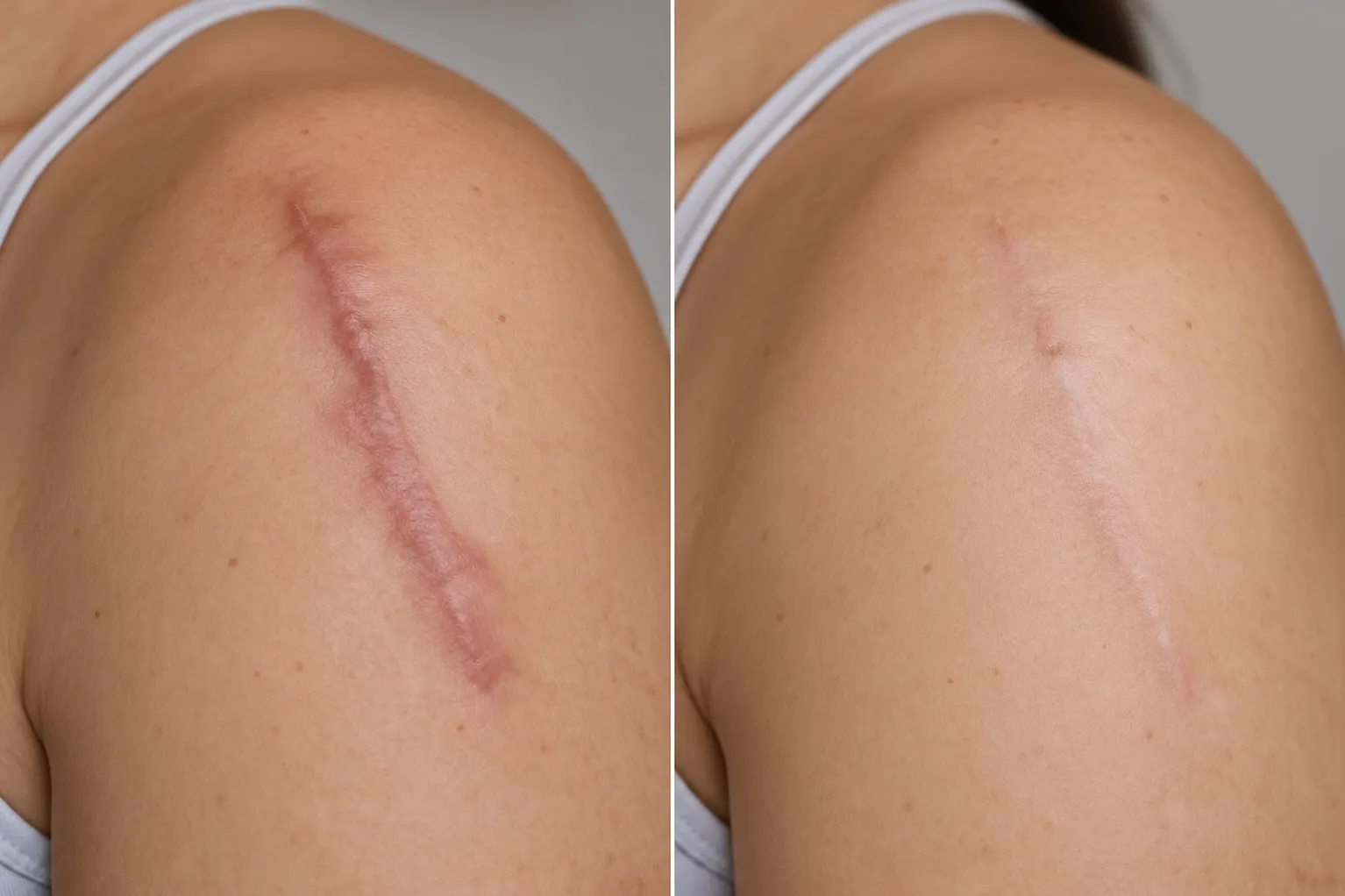
A scar is the body's natural response to injury, but scars can vary greatly in appearance. Some become flat and gradually fade, while others remain raised, widened, depressed, irregular or noticeably different in colour from the surrounding skin.
For people considering scar removal surgery, one of the most important expectations to establish is that treatment generally aims to improve a scar rather than erase every trace of it.
First Identify the Type of Scar
Not all scars respond to the same treatment.
Assessment may consider whether a scar is:
- Raised
- Widened
- Depressed
- Contracted
- Irregularly positioned
- Associated with previous surgery
- Caused by trauma
- Related to burns
- Affecting movement or function
The scar's age, location, direction and surrounding skin also influence treatment planning.
Surgery Is Not Required for Every Scar
Some scars may improve gradually with time. Other cases may be managed using nonsurgical approaches depending on the scar type and clinical findings.
Surgical scar revision is generally considered when altering the scar's position, width or contour could potentially improve its appearance or function.
This distinction matters because requesting scar removal does not automatically mean surgery is the best first treatment.
How Surgical Scar Revision Works
The surgical technique depends on the characteristics of the existing scar.
In selected cases, the old scar may be removed and the area carefully closed to create a more favourable scar. More complex scars can require techniques designed to change orientation, release tight tissue or reconstruct an affected area.
The objective is to create a scar that is less conspicuous or functionally restrictive, not to create scar-free skin.
Timing Can Affect the Treatment Plan
New scars continue changing during the healing and maturation process. Redness, firmness and visibility can evolve over many months.
Unless there is a functional problem or another reason for earlier intervention, a surgeon may recommend allowing sufficient healing before deciding whether revision is appropriate.
This is particularly relevant for patients who become concerned about a surgical scar soon after an operation.
Factors That Influence Healing
Scar formation is affected by many variables, including:
- Genetics
- Skin characteristics
- Location of the wound
- Tension across the area
- Infection
- Sun exposure
- Smoking
- Previous surgery
- Individual wound-healing response
Even technically well-performed surgery cannot guarantee an invisible scar.
Functional Scars Need Special Attention
Some scars are more than cosmetic concerns.
Burns, trauma and previous operations can occasionally produce contractures that restrict movement or distort nearby structures. In such situations, reconstructive planning may focus on restoring function as well as improving appearance.
For patients researching scar removal surgery in Jaipur, this distinction between aesthetic scar revision and reconstructive treatment is important.
What to Discuss Before Scar Revision
Dr. Nakul Somani assesses scars in Jaipur by considering their cause, maturity, location and impact before discussing appropriate management.
Patients should ask what degree of improvement is realistic, where the new scar may lie, what recovery involves and whether additional treatments might be useful.
People coming from other areas of Rajasthan should also consider follow-up requirements, particularly after more complex reconstruction.
Scar treatment works best when the goal is clearly defined. For one patient, improvement may mean making a widened scar finer. For another, it may involve releasing a tight scar that restricts movement. Understanding the specific problem helps determine whether surgery, nonsurgical management or simply additional healing time deserves consideration.
Keywords