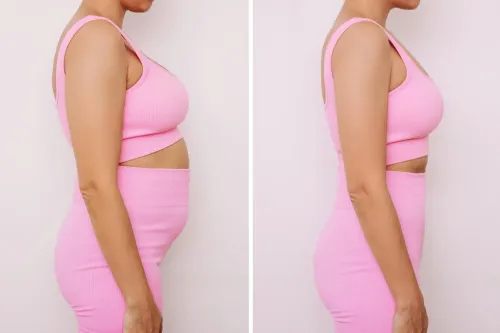
After major weight loss, a lower-abdominal fold can contain loose skin, residual fat, or both, while a bulge can come from muscle separation or a hernia. By the end, you will know which findings support consultation, how long to maintain your weight, and which operation fits the tissue that remains.
Key takeaways
- A hanging fold usually indicates redundant skin, but bulging needs examination.
- Reach a stable weight before planning body-contouring surgery.
- Choose the operation based on skin excess, fat, muscle separation and scars.
- Ask about pregnancy plans, hernia checks, recovery time and other loose-skin areas.
Is it loose skin, fat, muscle separation, or a hernia?
A hanging abdominal fold after major weight loss usually points to redundant skin, but a bulge can also come from residual fat, separated muscles, or a hernia. Loose abdominal skin after weight loss feels thin and empty, drapes when you stand, and remains loose when you lie down.
1. Stand sideways in good light, then lie flat. Skin laxity creates a fold that changes position with gravity; residual fat feels thicker and softer beneath the skin and remains present in both positions.
2. Look for stretch marks after weight loss. They show that the skin was stretched, but they do not prove that every part of the bulge is skin rather than fat or muscle.
3. Tighten your abdomen with a gentle partial sit-up. A ridge or doming along the midline suggests rectus-muscle separation, while a small, distinct bulge near the navel or a scar that becomes prominent with coughing points toward a hernia.
4. Stop examining the area if it hurts, becomes firm, turns red, or cannot flatten when you lie down. Seek prompt medical assessment for severe pain, vomiting, or a tender bulge.
A clinician can distinguish these causes with an examination and, when the finding is uncertain, ultrasound or other imaging. Abdominoplasty removes excess skin and can address muscle separation; it will not repair every hernia or remove all abdominal fat.
When is your weight stable enough to consider surgery?
Discuss surgery after your weight has stopped changing, not while you are still actively losing. A practical benchmark is six months stable weight, especially after major weight loss; further loss can create new hanging skin and change the planned excision.
There is no universal goal weight at which abdominoplasty becomes appropriate. BMI is one risk marker, not a pass-or-fail rule. The aim is a stable weight before tummy tuck surgery, alongside adequate health, suitable skin distribution, and realistic expectations.
A consultation is worth discussing when:
- You are near your goal weight and have maintained it for six months without an active plan for substantial further loss.
- Your blood pressure, diabetes, anaemia, and other medical conditions are assessed and controlled well enough for surgery and healing.
- You do not smoke or use nicotine. Nicotine reduces blood flow and raises the risk of wound separation, infection, and skin loss.
- You can pause strenuous exercise, lifting, and work during recovery and arrange help at home.
- You understand that a tummy tuck removes excess skin and may tighten lax muscles, but it is not a weight-loss operation and will not remove every area of fat or loose skin.
Exercise can improve abdominal strength and fitness, but it cannot remove a large hanging skin fold. If pregnancy is planned, discuss timing first because it can stretch the repaired tissues and alter the result.
Which operation matches the skin and fat you have left?
The right operation depends on the position of the loose skin, the amount of residual fat, and whether the abdominal wall needs repair.
| Option | What it addresses | When it fits |
|---|---|---|
| Full abdominoplasty | Lower-abdominal skin and fat, with possible muscle tightening | Skin hangs below the navel and laxity extends across the abdomen |
| Mini abdominoplasty | A smaller excess below the navel | The upper abdomen is firm and loose skin is limited to the lower section |
| Extended abdominoplasty | Abdominal excess continuing toward the hips or flanks | Weight loss has left side-to-side folds beyond a standard tummy-tuck scar |
| Fleur-de-lis abdominoplasty | Vertical and horizontal skin excess | Skin remains loose across the abdomen and also gathers significantly at the sides |
| Panniculectomy | The overhanging apron of skin and fat | The main problem is a heavy fold causing hygiene, rashes, or movement problems, without reshaping the abdominal wall |
| Liposuction | Localised fat with reasonably elastic skin | Fat is the problem; it cannot remove hanging skin and can make laxity more obvious |
| Combined surgery | Skin removal plus contouring or another repair | Separate problems need treatment, after reviewing the added operative complexity and risk |
| No surgery | Mild laxity or limited fat | Exercise, weight stability, or realistic acceptance offers a better risk-benefit balance |
A full or extended procedure may include repair of separated abdominal muscles, but that decision requires examination. Liposuction alone is the wrong tool for a loose fold. Non-surgical tightening also has limited effect when redundant skin is substantial.
How do pregnancy, scars, recovery, and other loose-skin areas affect the decision?
Future pregnancy after abdominoplasty is possible, but pregnancy can stretch repaired muscles and skin, compromise the contour, and leave you needing revision. If you expect to become pregnant, postponing elective surgery is usually the more predictable choice.
Before booking, weigh these decisions:
1. A tummy tuck scar is permanent, extending across the lower abdomen and sometimes around the hips in an extended procedure. It usually fades, but its width, height, and visibility depend on healing, genetics, tension, and sun exposure.
2. Abdominoplasty recovery requires help at home, limited lifting and strenuous exercise for several weeks, and gradual return to normal activity. Swelling and scar changes continue for months, so do not schedule surgery before work, childcare, or travel.
3. Complications include fluid collection (seroma), infection, wound separation, skin loss, altered sensation, blood clots, and contour irregularity. Nicotine restricts blood flow and raises wound-healing risk; expect a surgeon to require complete cessation and possibly a nicotine test.
4. Body contouring after bariatric surgery often involves loose skin on the flanks, back, breasts, arms, thighs, or pubic area as well as the abdomen. Treating one region can leave another looking disproportionate, so staged operations may be safer than combining every area at once.
Choose surgery only when the scar, recovery, risks, and whole-body result fit your priorities—not simply because one abdominal fold bothers you.
What should a consultation check before you choose surgery?
A sound tummy tuck consultation tests whether surgery is safe, useful and manageable for you, not just whether skin hangs. Your surgeon should review previous abdominal operations, scars, wound healing, diabetes, heart or lung disease, clotting problems, planned pregnancies and any history of hernia.
A hernia assessment matters when a bulge changes with coughing or standing; repairing it can alter the operation.
Ask for a clear plan covering these checks:
- Nicotine: smoking, vaping, chewing tobacco and nicotine replacement all matter because nicotine reduces blood flow and raises risks of skin loss, infection and delayed healing. Smoking and abdominoplasty are a poor combination; the surgeon may require a nicotine-free period and test urine before surgery.
- Medicines: disclose aspirin, warfarin, apixaban, steroids, anti-inflammatory drugs, vitamins and herbal supplements. Do not stop a prescribed anticoagulant without the prescribing doctor’s instructions.
- Risk: discuss blood clots, bleeding, seroma, infection, numbness, poor scars and wound breakdown—the main abdominoplasty complications—and how your risk changes with BMI and other conditions.
- Recovery: confirm who will take you home, provide help for several days, manage drains and dressings, and support early walking without lifting.
Dr Nakul Somani should also assess whether you can follow wound-care instructions and attend reviews; an operation is a poor choice if recovery support is unavailable.
| Review area | What to confirm | Why it matters |
|---|---|---|
| Abdominal history | Operations, scars, hernia symptoms | Changes incision and repair planning |
| Nicotine | All products and cessation testing | Affects blood supply and healing |
| Medication | Blood thinners, steroids, supplements | Alters bleeding and recovery |
| Daily life | Help, walking, wound care | Determines safe recovery at home |
Related services
Cosmetic Surgeries Abdominoplasty What is abdominoplasty (tummy tuck)? An abdominoplasty is a procedure that flattens your abdomen by removing extra fat and skin and tightening... |
Cosmetic Surgeries Get Tummy Tuck Cosmetic Surgery at Engrace Clinics for a Firmer,Well-Sculpted Abdomen Tummy Tuck in Jaipur You can get Tummy Tuck cosmetic surgery at... View service → |
Frequently asked questions
How can you tell whether abdominal looseness is skin, fat, muscle separation or a hernia?
Loose skin feels thin and empty, drapes when standing and remains loose when lying down. Residual fat feels fuller, muscle separation can cause a central bulge, and a hernia needs clinical examination.
When is weight stable enough to consider a tummy tuck?
Consider surgery after your weight has settled at a level you can maintain. Further weight loss can create new loose skin and alter the result.
Which operation matches the amount of loose skin and fat remaining?
The choice depends on where the excess skin sits, how much fat remains, whether abdominal muscles are separated and whether a hernia is present. A consultation determines whether limited or full abdominal surgery fits.
How do pregnancy, scars and other loose-skin areas affect the decision?
Future pregnancy can stretch repaired tissues and change the result. Previous scars, loose skin on the arms or thighs, and the need for staged procedures also affect planning and recovery.
What should a tummy-tuck consultation check before surgery?
The assessment should review weight stability, skin quality, fat distribution, muscle separation, hernias, previous scars, medical history, smoking, pregnancy plans and expected recovery.